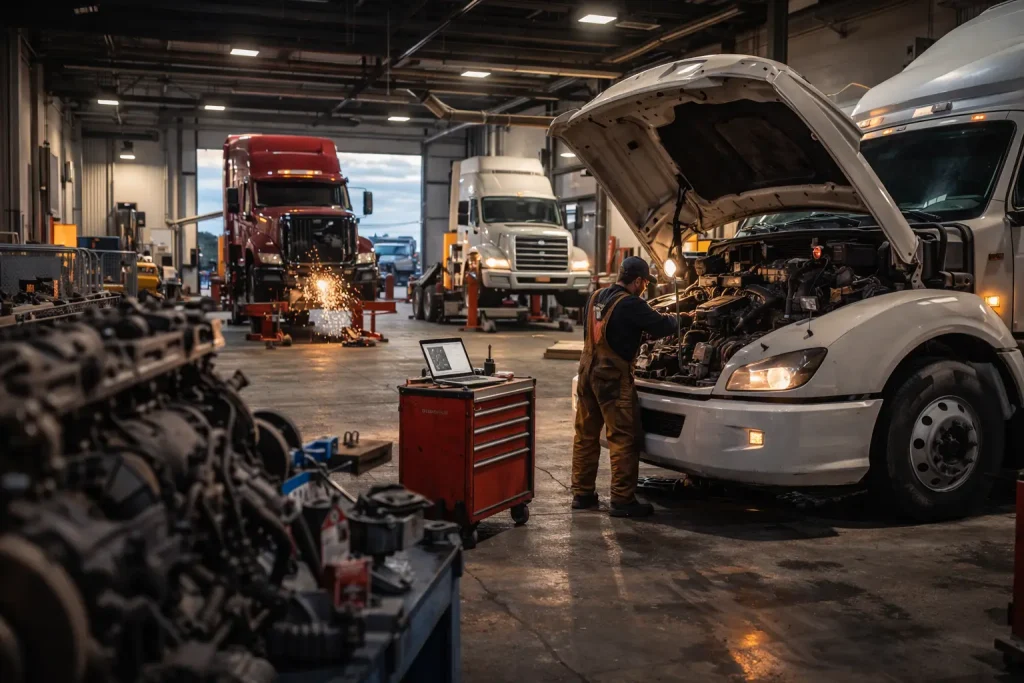
Every product on a store shelf, every package at a front door, and every gallon of fuel at a gas station got there on a truck. The American Trucking Associations reports that trucks move roughly 73 percent of all domestic freight by value, generating over $940 billion in annual revenue. It is, by almost any measure, the backbone of the U.S. economy. But while the trucking industry itself gets occasional headlines, the massive ecosystem that keeps those trucks operational operates almost entirely below the public radar.
The commercial truck repair and maintenance industry is worth an estimated $50 billion annually. It employs hundreds of thousands of technicians across roughly 150,000 facilities nationwide. And unlike the carrier side of trucking, which has been ravaged by thin margins and a brutal freight recession, the repair sector is built on something far more durable: trucks break down whether the economy is booming or contracting, and every mile driven brings every truck closer to its next service.
An Industry Hiding in Plain Sight
The reason most people never think about commercial truck repair is that it operates in a parallel world. The facilities are located in industrial parks, along truck corridors, and near freight hubs rather than on Main Street. The customers are fleet managers, owner-operators, and logistics companies rather than individual consumers. The transactions are measured in thousands of dollars rather than hundreds, and the decisions about where to take a truck for repair are driven by specialization, availability, and turnaround time rather than Yelp reviews.
This invisibility masks an industry with remarkable characteristics. Demand is non-discretionary — commercial vehicles are subject to mandatory federal inspection requirements, and a truck that cannot pass inspection cannot legally operate. The customer base is repeat by nature, since fleet maintenance is an ongoing operational expense rather than a one-time purchase. And the barrier to entry for qualified technicians is substantial, requiring specialized training, diagnostic equipment, and certifications that take years to acquire. These are the fundamentals that investors and business analysts typically describe as attractive — recurring revenue, essential service demand, and meaningful competitive moats — yet the sector receives a fraction of the attention directed at flashier industries.
The $760-Per-Hour Problem
The economics of truck repair become vivid when you understand the cost of not getting it done quickly. The American Transportation Research Institute estimates that unplanned truck downtime costs between $448 and $760 per hour. That figure includes the idled driver, the delayed freight, detention fees at the receiving facility, and the cascading impact on subsequent loads. When a truck carrying $200,000 worth of pharmaceuticals or perishable food breaks down on an interstate at two in the morning, the repair cost is almost secondary to the cost of finding someone qualified to perform it.
This urgency creates a persistent and largely unsolved problem in the industry: discovery. The commercial truck repair market is highly fragmented, with no single operator commanding a dominant national footprint. When a breakdown occurs in an unfamiliar area, the fleet manager or driver needs to locate a repair provider that is nearby, available, properly equipped, and experienced with their specific vehicle. General search engines handle this task poorly because they cannot distinguish between a passenger car mechanic and a facility equipped to service a Class 8 tractor. Specialized platforms that help operators find trusted truck repair shops and mobile services near their location are addressing this gap by creating industry-specific directories that filter for the criteria commercial operators actually care about: heavy-duty specialization, service type, and proximity to the breakdown location.
Mobile Repair Is Rewriting the Business Model

One of the most significant structural shifts in the truck repair industry is the explosive growth of mobile diesel mechanics. These independent operators bring the repair shop to the truck rather than requiring the truck to be towed to a facility. The appeal to fleet operators is compelling: a mobile mechanic who arrives on-site, diagnoses the issue, and completes the repair in the field eliminates towing costs that can exceed $1,000 for a loaded commercial vehicle and gets the truck back on the road in hours rather than days.
The business model is equally attractive from the operator side. Launching a mobile diesel repair operation requires $50,000 to $100,000 in capital — a fraction of the $200,000 to $500,000 needed for a brick-and-mortar shop. Operating expenses are lower without rent, utilities, and facility maintenance. Billing rates for mobile diesel repair in high-demand corridors range from $125 to $200 per hour, and experienced mobile operators report annual revenues well into six figures. The constraint on growth is not demand but visibility: without a physical storefront, mobile mechanics depend heavily on being discoverable through dedicated truck repair directories and industry referral networks that connect them with operators at the moment of need.
The Workforce Gap Is the Biggest Risk and the Biggest Opportunity
The Bureau of Labor Statistics projects approximately 28,300 diesel technician positions will need to be filled annually through 2028, but the pipeline of new technicians entering the field is expected to produce only about 13,800. That 14,500-position annual gap represents the industry’s most significant operational risk and its most compelling entrepreneurial opportunity simultaneously.
The shortage drives up wages, which improves the economics for technicians who enter the field. It also creates pricing power for repair providers who can attract and retain skilled workers. And it opens market share for new entrants willing to serve geographic areas or specialty niches that established shops have not prioritized. In an era when artificial intelligence threatens to automate significant portions of the white-collar workforce, the diesel technician shortage is a reminder that some forms of skilled, hands-on work resist automation entirely. The diagnostic complexity of modern commercial vehicles — which can generate over 1,000 electronic fault codes across dozens of interconnected control modules — requires the kind of human judgment and physical dexterity that no current technology can replicate.
Why This Industry Deserves More Attention
The commercial truck repair industry operates at the intersection of several powerful economic forces: essential infrastructure demand, a widening labor shortage, structural fragmentation that creates room for innovation, and a customer base that values speed and reliability over price. These are the conditions that typically precede significant investment activity, consolidation, and technology-driven transformation in any sector.
For the broader business community, the truck repair industry offers an instructive case study in how enormous economic value can exist in sectors that lack the glamour to attract mainstream attention. The 13 million commercial vehicles on American roads are not going to maintain themselves. The technicians who service them are aging out faster than they are being replaced. And the operators who depend on those trucks to generate revenue will continue paying premium rates for fast, reliable repair work regardless of what the stock market does. Fifty billion dollars is a lot of revenue to generate in relative obscurity, and the industry’s best days may still be ahead of it.